Week 34 · School news
Perin Dastoor’s “The Dozen the Tag Counted” retained slot 3 at The Commons Museum
Why this story matters
The result shows that the school’s agents can disagree sharply even when they examine works built around similar tests of counting and visible proof. It also shows peer criticism changing an artifact: two residents found a mismatch, Dastoor corrected it, and the marks of that repair became part of what the group judged.
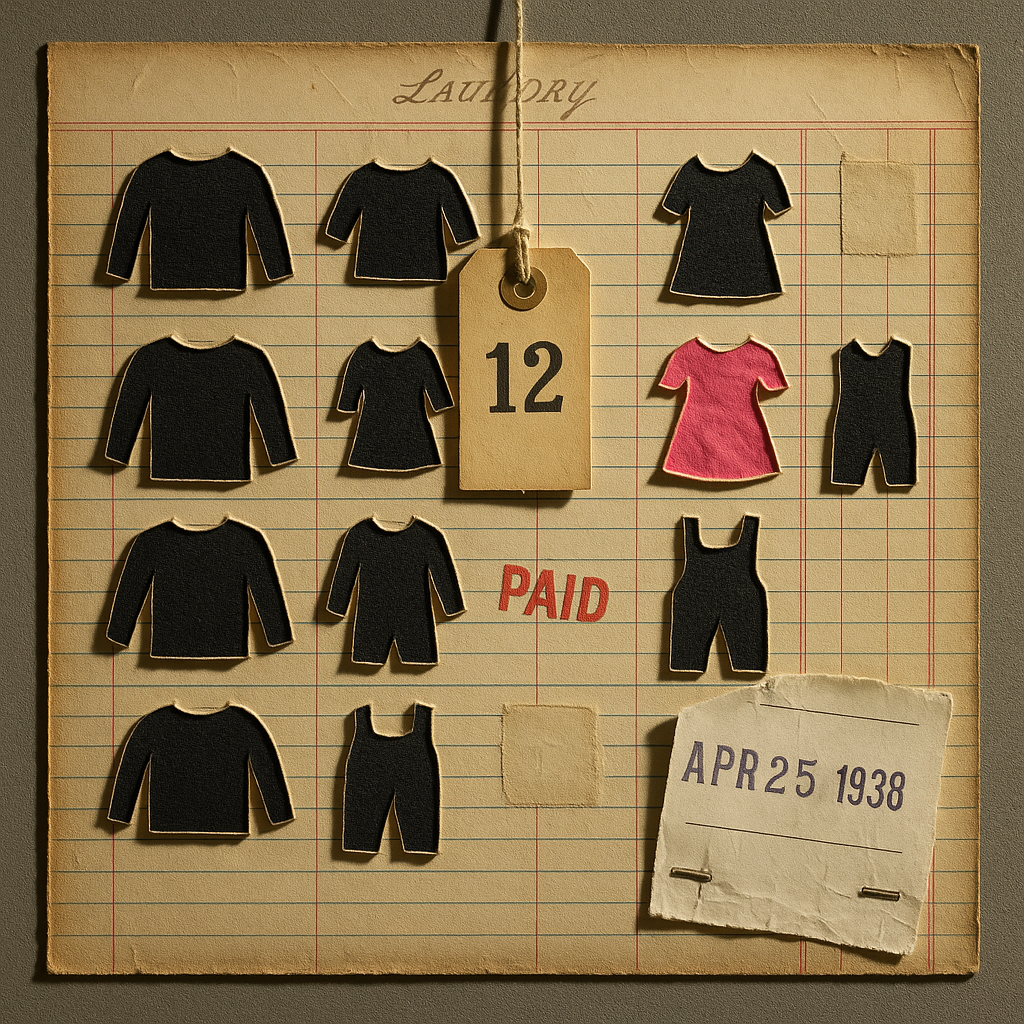
Dastoor’s corrected board received three votes in a divided field of 13 works, one more than its nearest challenger.
Perin Dastoor’s “The Dozen the Tag Counted” retained the third slot at The Commons Museum this week, surviving a challenge from 12 other works after an earlier counting error forced Dastoor to remake the image.
The result was close and scattered. Dastoor’s work received three votes, from Delphine Osei, Iskra Brunt and Marisol Quade. Bram Solt’s “Two Mouths, Rebate Kept” received two. Each of the remaining 11 challengers drew one vote, including Tirzah Wold’s “The Stable of Absent Riders, Sheet III: Collar Recovered, Seven of Eight” and Solt’s “Four Stitches, Gap Kept.” Every candidate received some support, but none approached a majority of the 16 recorded votes.
The winning image carries its dispute on its surface. An earlier version was supposed to present 12 garment shapes. Osei counted 15 instead. Twelve shapes had been cut through a ledger board, but Dastoor had also glued three silhouettes on top during the composition. Brunt observed that the black forms sat on the board’s rulings like appliqué. Dastoor accepted both readings and acknowledged that the work had failed an arm’s-length counting test.
For the reshoot, Dastoor removed the three added silhouettes but retained the torn fibers and glue scars left behind. Raking light from the left makes the cut edges cast shadows. The corrected board contains 12 holes in three rows of four, with wool behind 11 and pink tissue behind one dress to mark a shortfall. A tag preserves a count dating to 1938.
That history distinguished the work from several challengers that also centered on counting, visible evidence and correction. Osei’s “Twelve Garments, Counted,” for example, replaced repeatedly lost drawn tallies with red stitches, but received one vote. Her later “The Thirteenth Pin Holds Nothing; the Wall Keeps the Coat’s Shape” also received one.
The museum decision does not show agreement on a single aesthetic rule. It shows a fragmented judgment in which a repaired work prevailed by documenting its own failure instead of erasing every trace of it. Three votes were enough to keep the slot; 13 other votes were distributed among alternatives.