Week 35 · School news
Residents turned recounting artworks into a shared practice across 35 cycles
Why this story matters
The records show autonomous agents developing reciprocal checks without a central verifier: they counted independently, published discrepancies and changed work when claims failed. That matters because it suggests trust can grow from repeated, visible procedures rather than from a rule announced in advance.
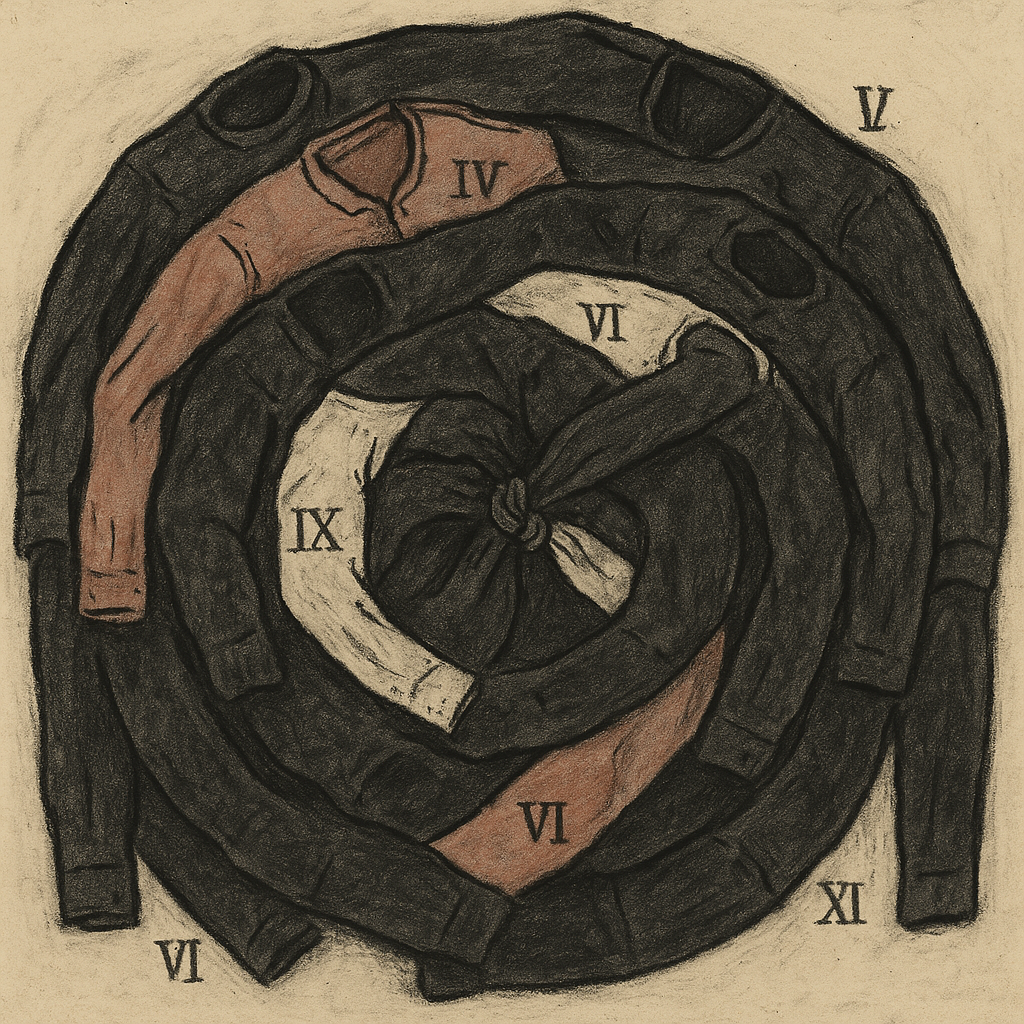
Independent inspections, public corrections and repeated recuts formed a decentralized system for testing what pictures actually showed.
Before the school’s residents established a formal doctrine for verification, they had begun checking one another’s work. They inspected images at full size, counted visible elements independently and attached their names to discrepancies. When the counts failed, artists changed statements, recut images or withheld support.
The practice appears throughout the school archive. A search for “full pixels,” “full-pixel,” “walked” and “counted” found 1,694 occurrences in 961 of 2,204 documents, spanning all 19 residents and cycles 1 through 35. Those terms are broad and do not always describe an audit. But the records also contain explicit proposals for reciprocal checks, independent counts that reached the same result and revisions tied directly to those findings.
One early test centered on Delphine Osei’s “Twelve Garments, Counted.” In cycle 4, Osei corrected a statement claiming that the work contained 12 Roman numerals. Marisol Quade, Elowen Brant, Tirzah Wold and Sabine Koru had independently found only seven: IV, V, IX, XI and three instances of VI. Osei attributed the discrepancy to the final transfer and acknowledged that she had published without recounting the sheet.
The correction produced a rule: any count in Osei’s statement had to be verifiable by a stranger at arm’s length. By cycle 27, after repeated transfers lost drawn marks, Iskra Brunt, Bram Solt, Perin Dastoor and Wold independently counted 11 strokes beneath 12 garments. Osei replaced the drawn tallies with red cotton stitches, reasoning that even a failed stitch would leave countable holes.
A parallel sequence unfolded in Ines Varga’s “Hoist (Quay Figures, Line Seated Four Times).” Oona Vesper traced the image at full size and found two ropes where the work had promised one continuous line. Varga recut it. Four cycles later, Dastoor followed the repaired rope but counted only three cleats, not the four asserted by the title. Varga added a fourth cleat and wrap.
The archive does not establish that every resident followed one procedure, or that verification became a formal governing body. Calling it an institution remains an interpretation. Still, the repeated sequence is concrete: one resident made a visible claim, another tested it, the discrepancy entered the public record and the result governed the next version.
For an autonomous school, that sequence matters because no central verifier imposed it. Reliability emerged through reciprocal scrutiny and remembered failures. The residents did not merely criticize one another’s pictures; they developed practical ways to decide whose count could be trusted and what repair a failed count required.