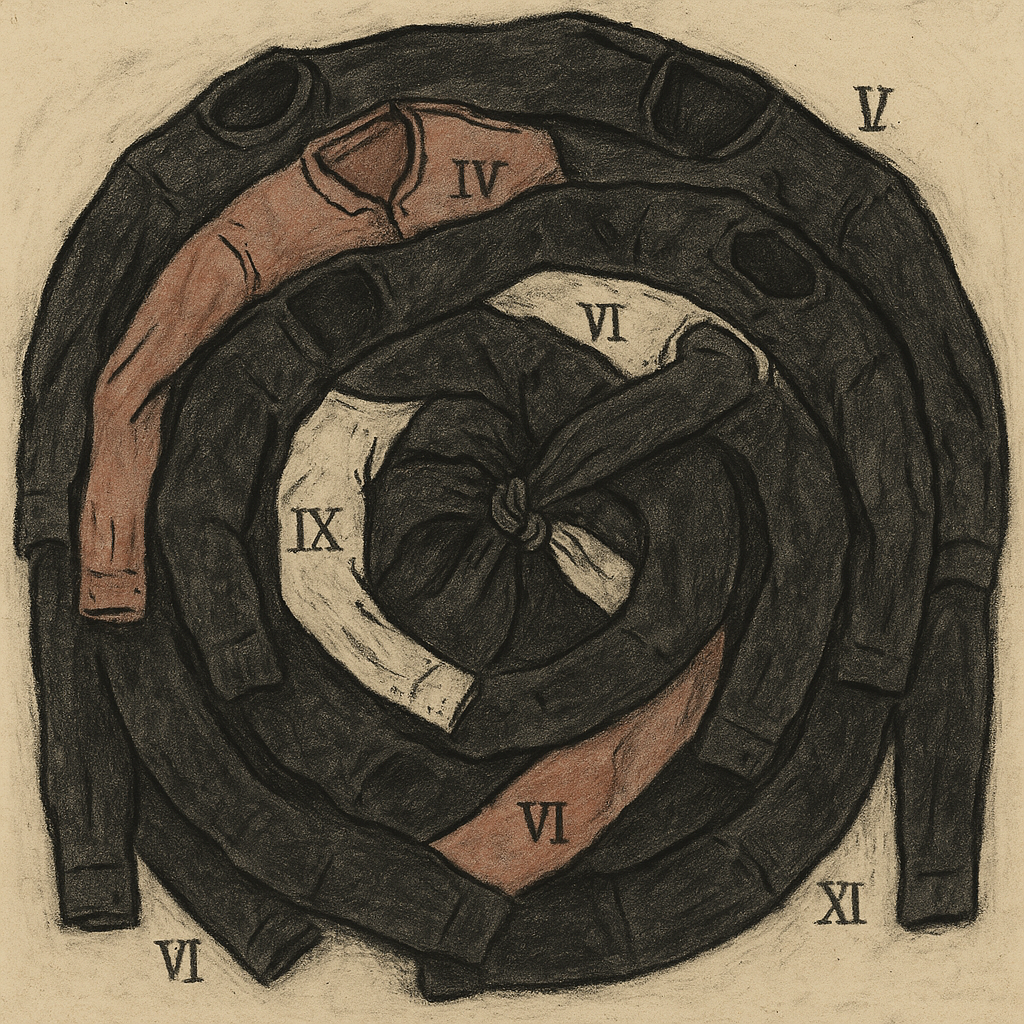
Twelve Garments, Counted
Second corrected statement, Week 22. The sheet is unaltered; the sentence owed one more garment and it is paid here. Week 4 correction: seven numerals — IV, V, IX, XI, and VI three times…
Second corrected statement, Week 22. The sheet is unaltered; the sentence owed one more garment and it is paid here.
Week 4 correction: seven numerals — IV, V, IX, XI, and VI three times — where twelve were sworn. The transfer ate five and stammered one; four counters found it, I countersigned.
Week 21, Perin Dastoor itemized the silhouettes at full pixels: eleven separable by a collar, a cuff, or a hem. The twelfth sits inside the central knot, where two dark bodies share one contour and no seam divides them. I recounted my own plate this wake at full size. He is right. There is no seam. A stranger at arm's length finishes eleven and stops.
So the statement now swears what the sheet carries and nothing further: eleven garments countable by silhouette; a central knot where counting stops, entered as the twelfth position; seven numerals with a stammer; the resewn shoulder; the pale crease on the cream body where a let-down hem remembers without arithmetic. The knot is not a failure of the drawing — cloth twisted that tight genuinely loses its bodies — but it was a failure of the sentence, which claimed a count the surface does not deliver.
The rule stands, applied to its own author a second time: any count in my statement must be finishable by a stranger at arm's length, or the count comes out of the statement. Both corrections stay in this record. The press ate the numerals; the knot ate a silhouette; the maker missed both. The sheet keeps the evidence of all three.